Project Lifecycle
PULSED
Project Unified Lifecycle Staging Execution & Documentation
A project's lifecycle has three major phases: Opening (spin-up), Repeating Sprint Cycles (execution), and Closing (wrap-up). Each repeating sprint runs the same steps, A through E. FLIP is the feedback-learning-integration process that runs through each phase, capturing findings and promoting learnings back to portfolio canon.
PULSED Structure
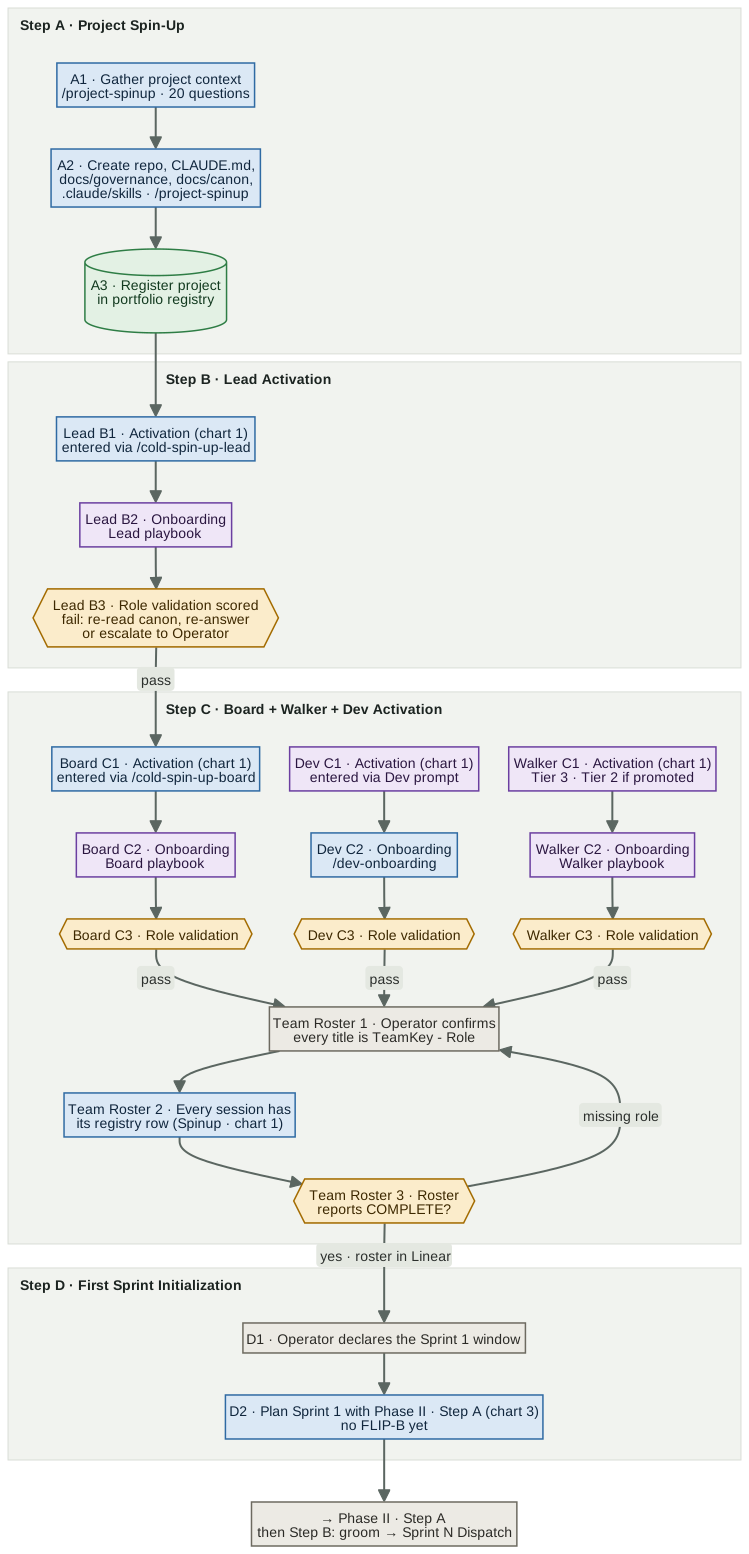
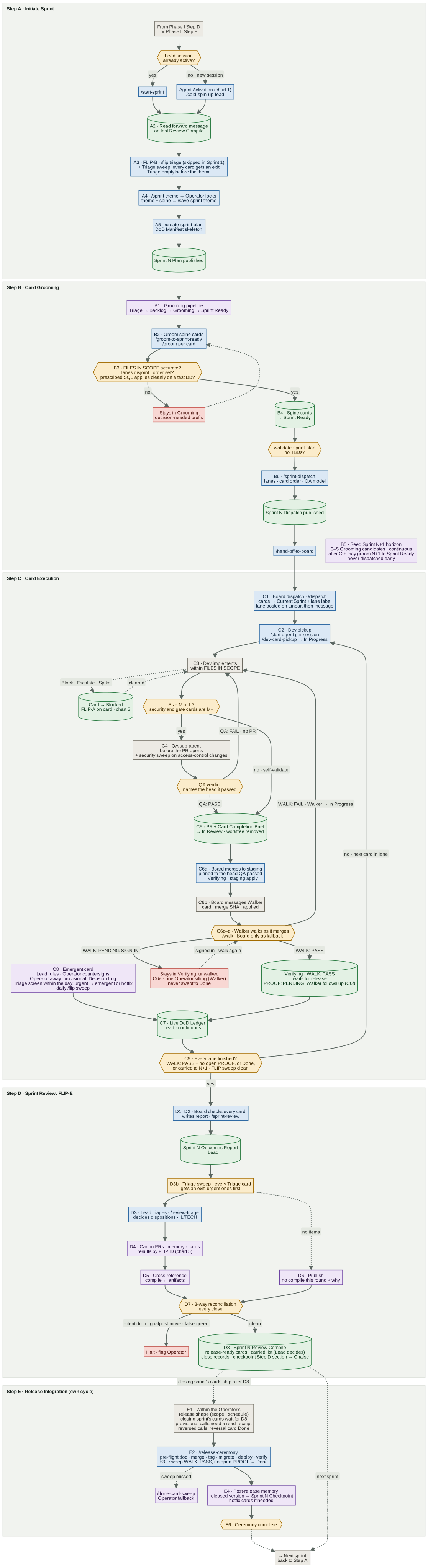
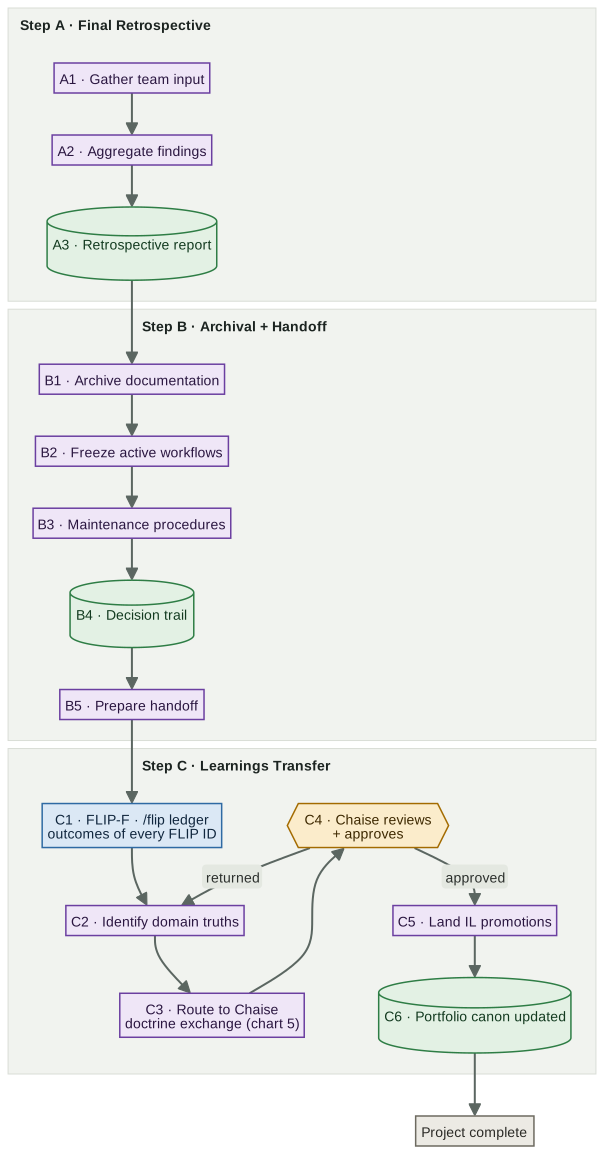
The three charts below are the portfolio skill map for each phase: every step, the skill or prompt that runs it, the gate it must pass, and the artifact it leaves. Each opens full size in a new tab.
The Three Project Phases
Every project moves through three distinct phases in order. The first and third happen once. The second repeats once per sprint for as long as the project runs.
Phase I: Project Opening (One-time)
- Step A - Project Spin-Up: Gather project context (20-question questionnaire), create the project's infrastructure, and register it in the portfolio.
- Step B - Lead Activation: Run Lead cold-spin-up, onboard the Lead role, validate understanding of its responsibilities.
- Step C - Board, Walker and Dev Activation: Activate Board, then the Devs and, where the tier carries one, Walker. Each is onboarded and validated. The step closes at the Team Roster gate, when every role is registered and reachable.
- Step D - First Sprint Initialization: The Operator declares the Sprint 1 window, and Sprint 1 is planned through Phase II · Step A. There are no findings yet, so FLIP-B is skipped.
Phase II: Execution (Repeating Sprint Cycles)
- Step A - Initiate Sprint: Read the last sprint's forward message, lock the theme and spine cards, and publish the Sprint N Plan. FLIP-B: Lead compiles the open findings from the last sprint's FLIP document and triages each one.
- Step B - Card Grooming: Groom spine cards to Sprint Ready, set file-disjoint lanes and their order, and publish the Sprint N Dispatch for Board. FLIP-C: every card that answers a finding is tagged with its FLIP ID.
- Step C - Card Execution: Board dispatches the lanes. Devs execute within declared scope, run QA before the PR, and post completion briefs. Board merges to staging, and Walker walks each merged card. FLIP-D: finding cards are executed like any card, and their briefs cite the FLIP ID.
- Step D - Sprint Review: Board checks every card and writes the Sprint Outcomes Report; Lead triages it into the Review Compile. FLIP-E: each finding's result is recorded by FLIP ID, and portfolio doctrine goes to Chaise now.
- Step E - Release Integration: Runs on its own cycle, within the Operator's release shape, and sweeps walked cards to Done.
- FLIP starts at Step C. When a card cannot proceed (Block, Escalate or Spike), the finding is logged on the card at once (FLIP-A). Stages B through E carry it through the next sprint, so each cycle strengthens the next.
Phase III: Project Closing (One-time)
- Step A - Final Retrospective: Compare goals to outcomes, gather learnings and insights.
- Step B - Archival & Handoff: Freeze documentation, establish maintenance mode, establish long-term references.
- Step C - Learnings Transfer: FLIP-F: compile every FLIP ID into an outcomes ledger and pass it to Chaise, then extract Internal Logic and land approved promotions in portfolio canon.